Cocktail of Uncertainty
I recently purchased Cocktail Codex—a book about mastering the fundamentals of classic cocktails in order to learn how to create original variations. It’s a splendid book, and I highly suggest it if you’re interested in learning how to mix drinks… but that’s not what this post is about. Within the taxonomic infographic for each cocktail, it visualized the makeup that defined it.

This got me thinking—could a similar visualization be used to capture the makeup that defined a game? In his book Uncertainty in Games, Greg Costikyan posits that uncertainty is an essential part of play, so I decided to test a hypothesis: that the combination of uncertainty in games is the defining characteristic of its identity.
What Are The Types of Uncertainty?
Before looking into the uncertainty makeup of games, we need to go over the types of uncertainty. Here is my framework, borrowed and tweaked from Costikyan’s.
Randomness — Uncertainty from Chance: It’s no coincidence that some of the most iconic symbols of games—the die and the playing card—are elements of chance. From simply determining the first player to determining everything about the game, randomness’s effect on games is vast.
Analytic — Uncertainty from Complex Trade-Offs: Although it may not be commonly thought of as uncertainty, the inability to see clearly through the downstream effects of a decision is an uncertainty. While randomness has an irreducible uncertainty, analytic uncertainty is relative to the player: as mastery is achieved, the uncertainty shrinks. Randomness & Analytic uncertainty combine into statistical analysis. You can make the right choice, but still have the wrong outcome.
Player — Uncertainty from the Decisions of Others: Most multiplayer games have sources of interaction between the players, and this interaction results in player uncertainty. What will your opponents do?
Hidden-Information — Uncertainty from Incomplete Information: Sometimes, information is partial. In some cases, this may be random information, doled out to individual players as in a hand of cards. It may also be information hidden in a game system, such as an adventure booklet. Or, perhaps information hidden by the other players. In each case, not having the full picture drives the uncertainty.
Skill — Uncertainty from the Execution of a Skill: Many games require skills beyond just analysis. This type of uncertainty comes from when you know what you need to do, but you’re uncertain if you can do it.
Solver’s — Uncertainty from the Solving of a Puzzle: There is a similar feel between Solver’s and Analytic uncertainty, but the distinction lies in the answer. With solver’s uncertainty, there is at least one unambiguous right answer, determined by an in-system source. It echoes “skill” uncertainty—you know there is an answer, but can you find it?
Deciding A Shape
The visualization in Cocktail Codex were pie charts. I experimented with this, but it felt like it de-emphasized the absence of an “ingredient.” Instead, I opted to use a radar chart. This helped to give each combination a distinctive shape.
I also experimented with which types of uncertainty to use. I tried a few with all six listed above.
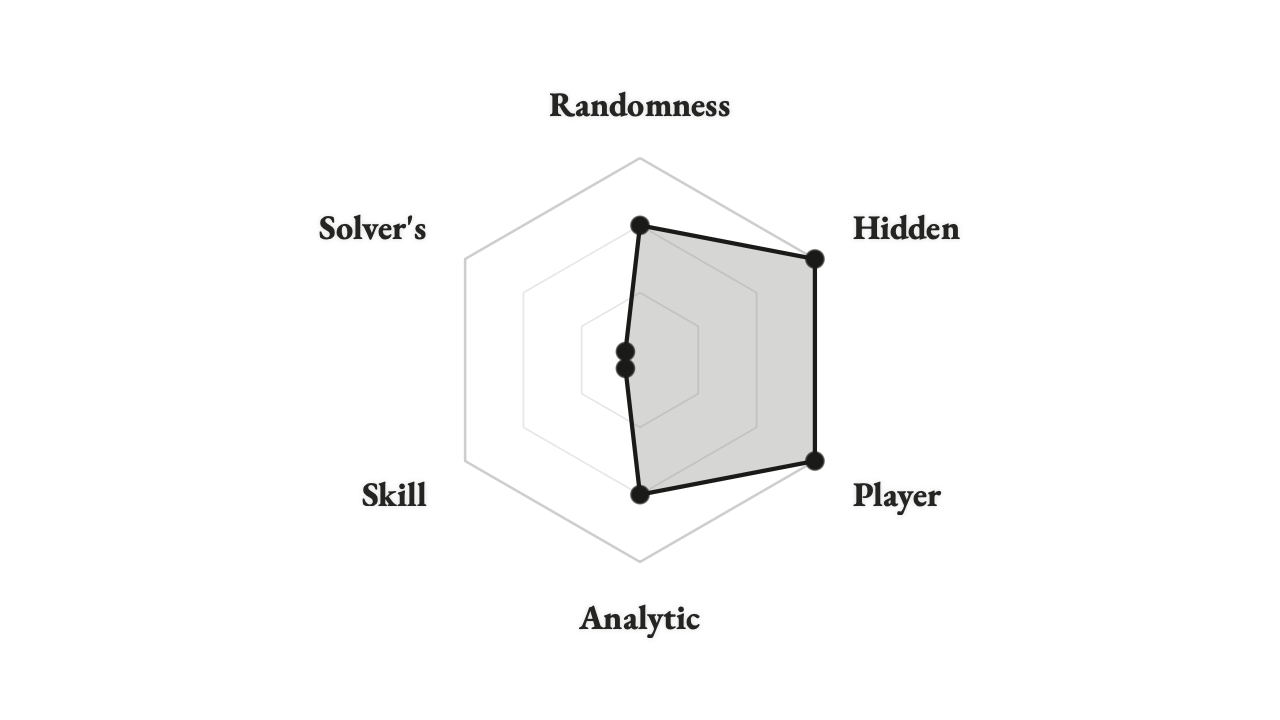
In the end, I found that both Solver’s and Skill uncertainty were fairly uncommon outside of certain types of games (i.e., Skill in dexterity games, Solver’s in deduction games). In favor of easy scanning at the cost of comprehensiveness, I decided to just use Analytic, Randomness, Player, and Hidden-Information.
Types of Games, And Their Uncertainty
Here are a few different genres and a general shape of their uncertainty. The specifics will vary from games within the genre.
The Abstract Strategy
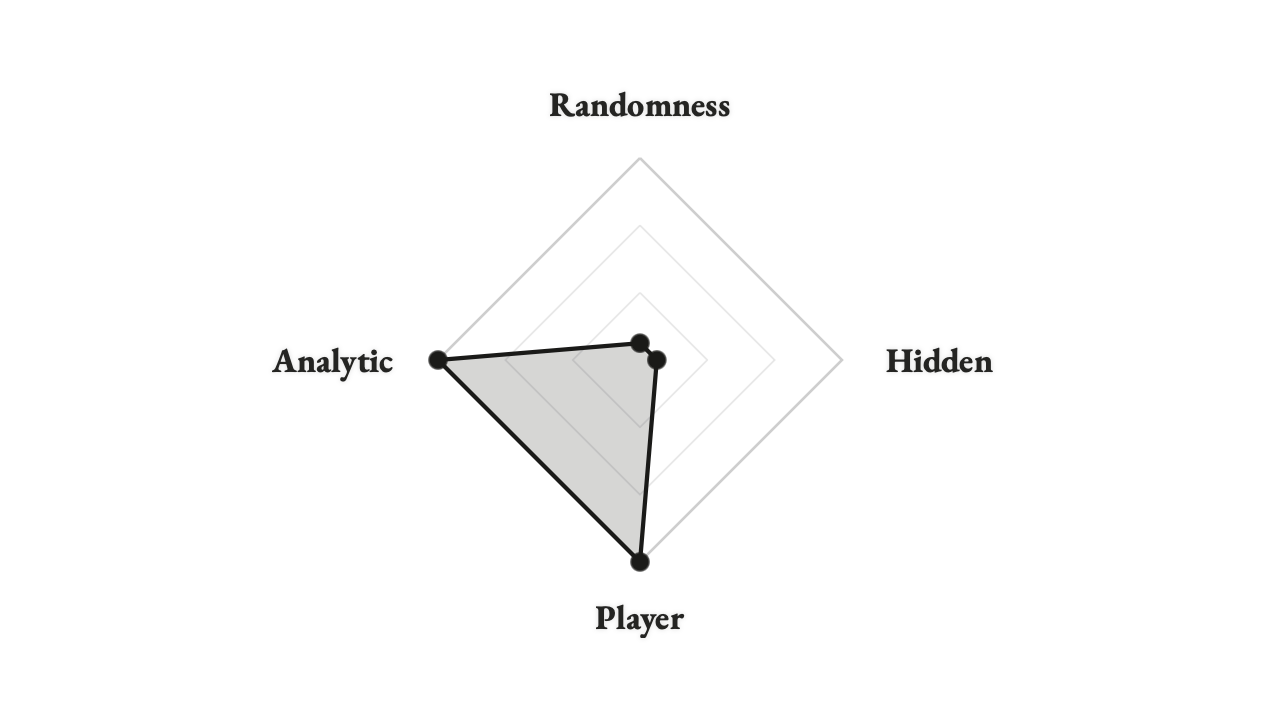
The abstract strategy is defined by its perfect information core. No hidden-info and no randomness—just your analysis versus your opponent’s analysis.
Examples: Chess, Go, Hive, Patchwork
The Traditional Roll & Move
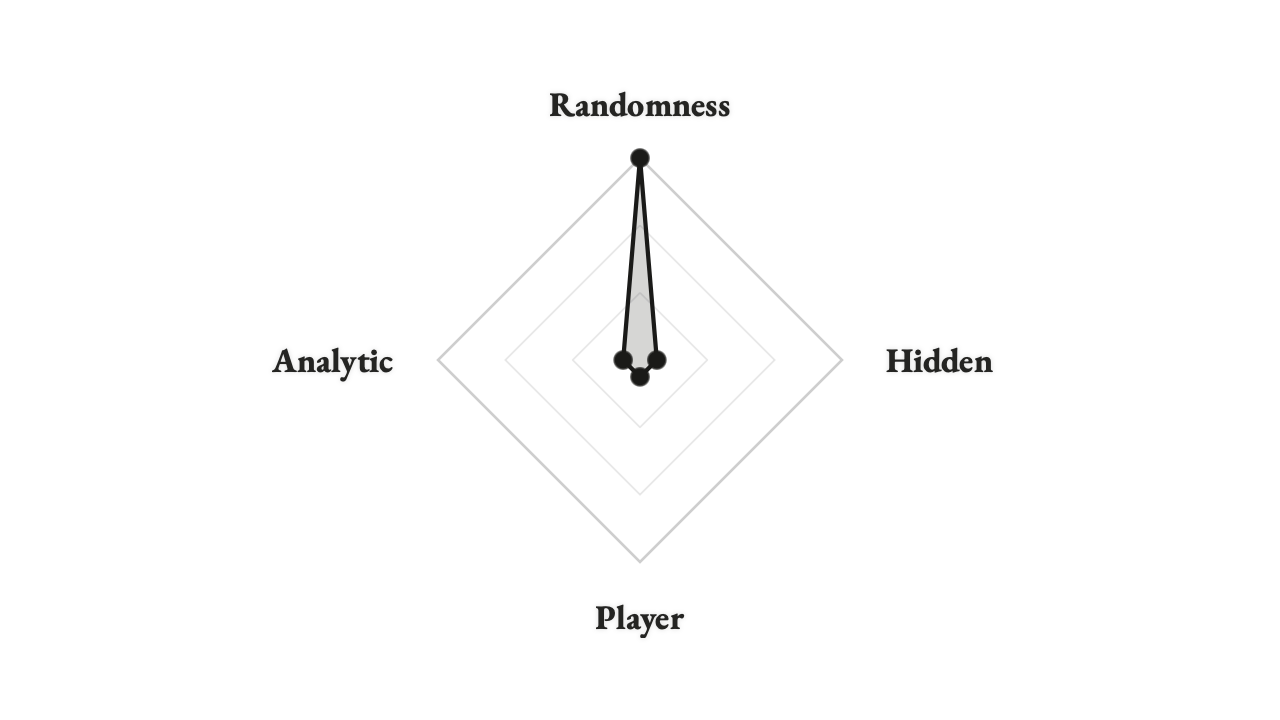
In contrast, the traditional roll-and-move is defined by its near-to-complete lack of agency. Let the fates decide.
Example: Chutes & Ladders, Parcheesi, Magical Athlete (if you add a sprinkle of analytic)
The Social Deduction
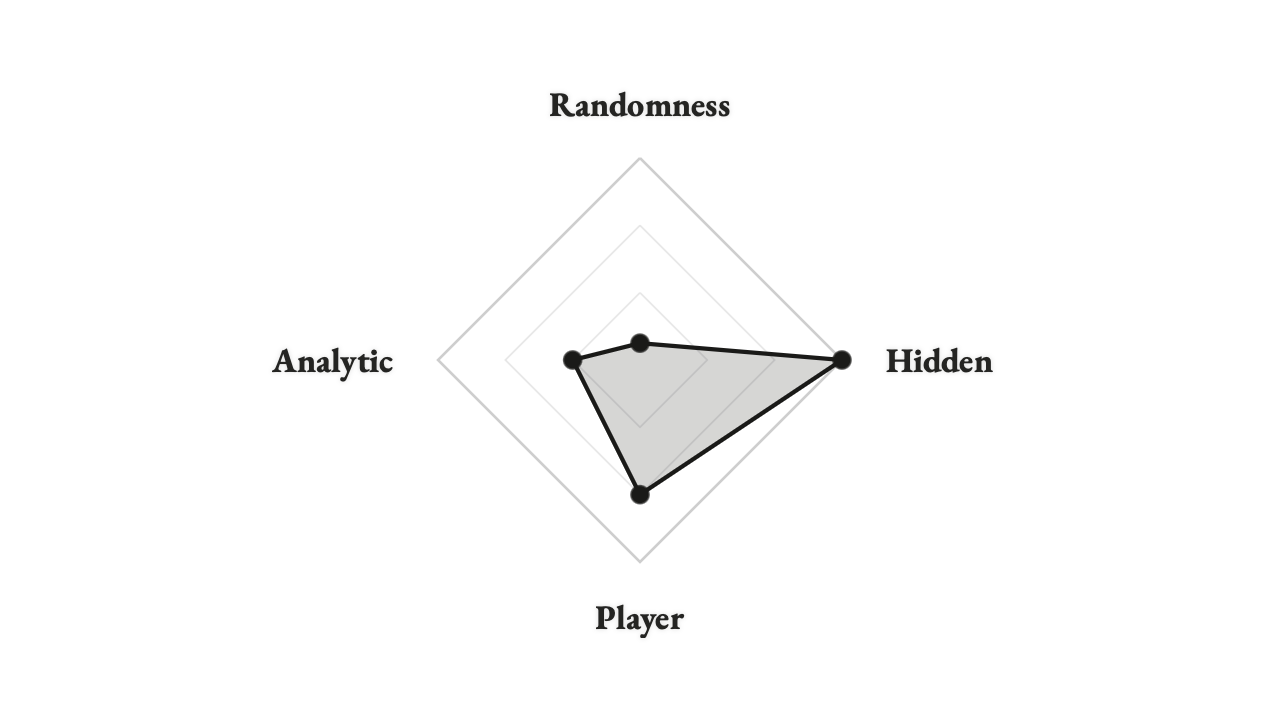
Social Deduction is more about what you don’t know than what you do. This genre is defined by an asymmetric sharing of information.
Examples: Werewolf, The Resistance, Blood on the Clocktower
Optimization Puzzle
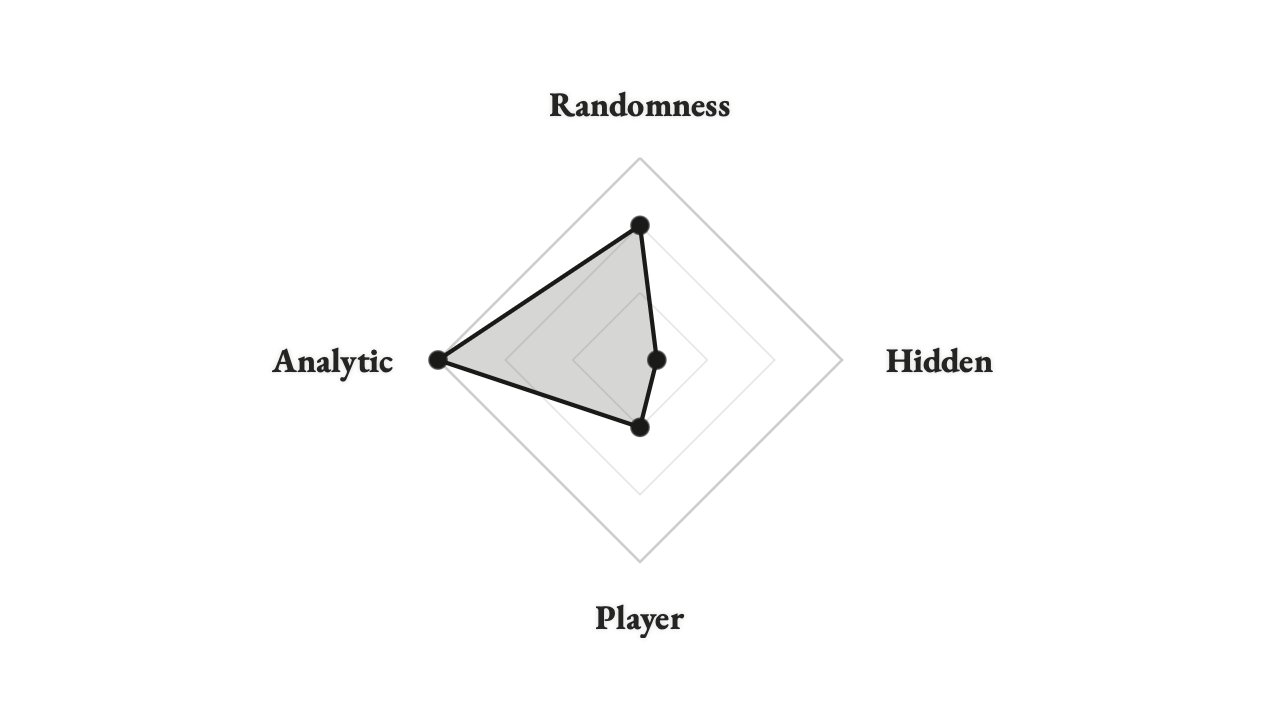
Optimization puzzles are all about efficiency—you have to do the best with what you are given.
Examples: Cascadia, Harmonies, That’s Pretty Clever!
The Heavy Euro
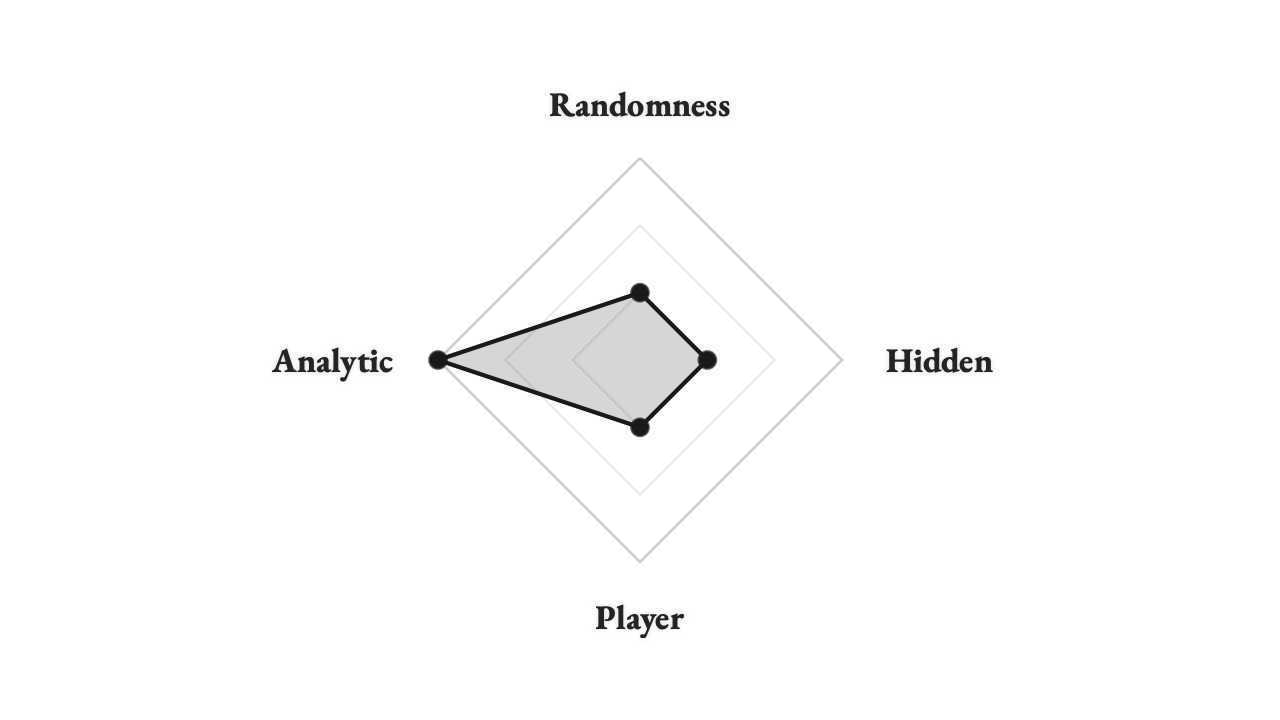
Heavy Euros are primarily analytic, with the other uncertainties in a supporting role varying from game-to-game.
Examples: Games by Vital Lacerda. Probably.
Classic Card Games
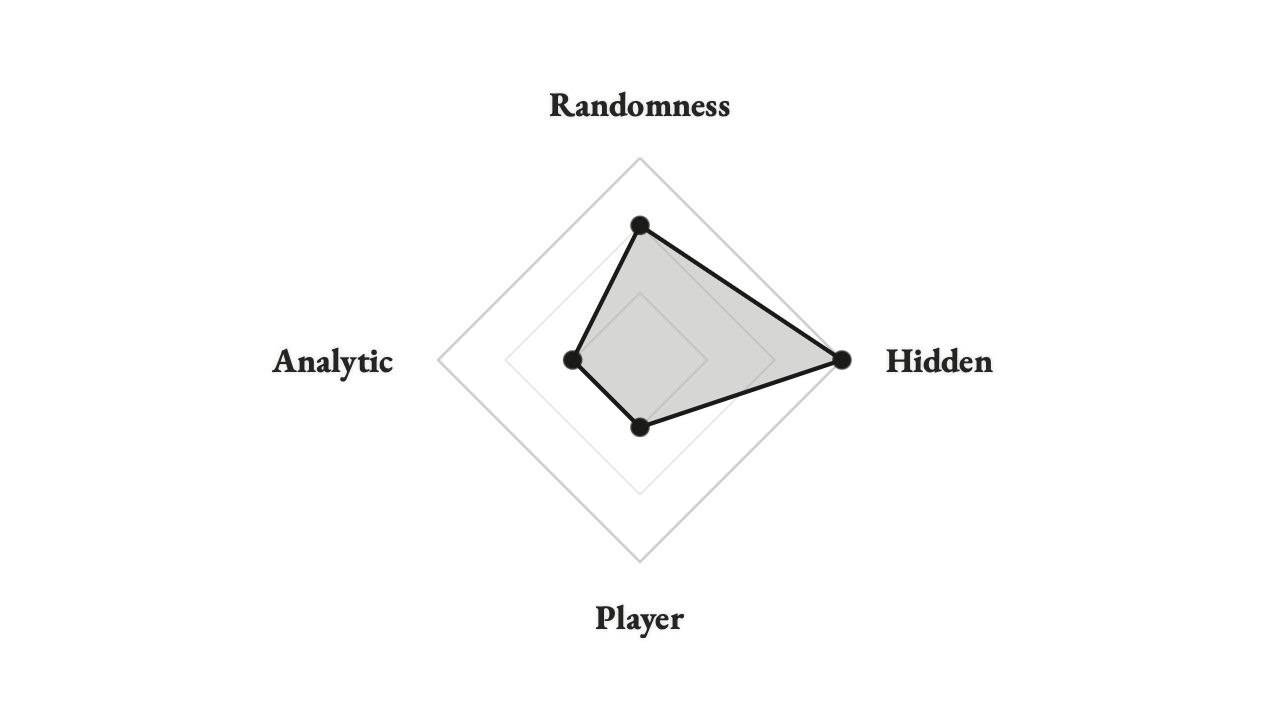
Classic card game styles, such as trick-takers and ladder-climbers, are heavily driven by hidden-information in the players hands and a random deal. The analytic and player uncertainties can vary greatly from game-to-game.
Examples: Spades, Haggis, Lost Cities
Does This Model Work?
So, is there any use to viewing games this way? I think that this lens does help to shed some light. There is often a conflation between mechanics and genre in board games, and I think the uncertainty helps to alleviate some of this confusion. For example, let’s look at three different tile-laying games by Reiner Knizia.
Through the Desert

Through the Desert is a perfect information game. The only uncertainty comes from the other players and your ability to see the consequences of your actions.
Tigris & Euphrates
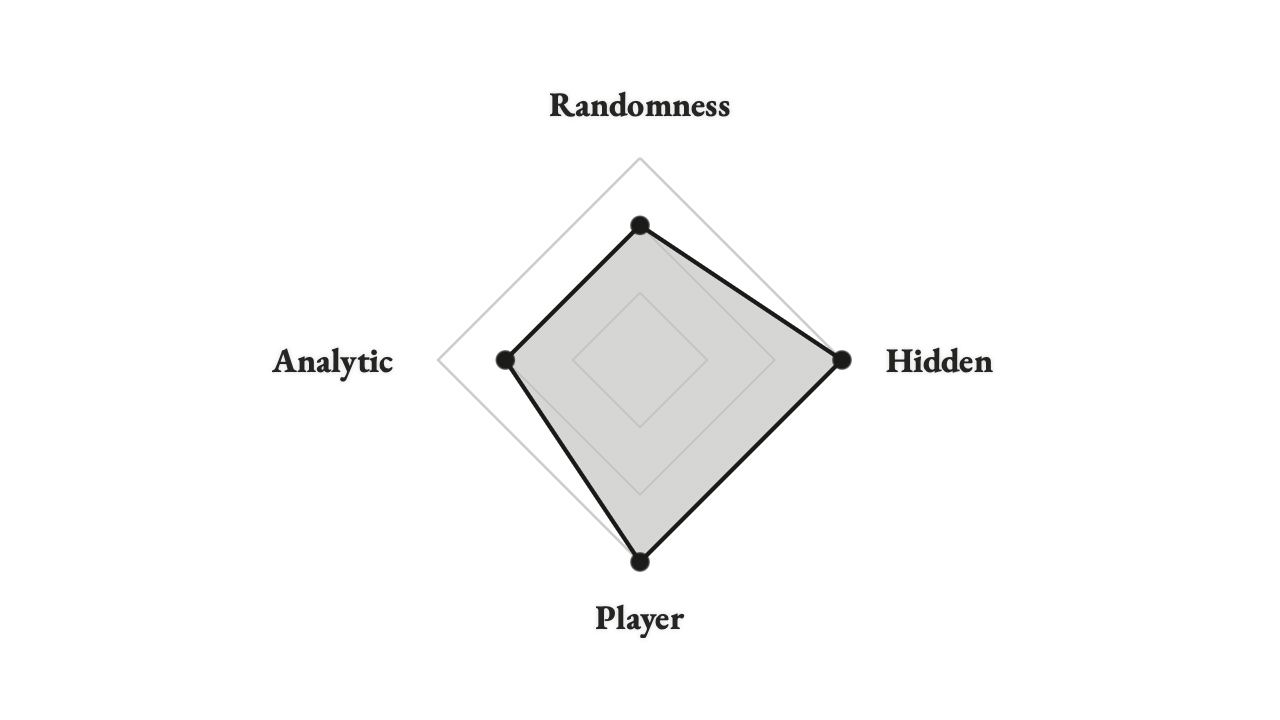
Tigris & Euphrates, by contrast, adds a healthy dollop of hidden-information. This drastically changes the game-feel—due to the hidden information of your opponents’ hand of tiles, you can’t analytically delve down the decision tree.
My City
My City falls neatly into the ‘optimization puzzle’ style of tile-laying. There is some light interaction, but primarily the uncertainty is randomness and analytic.
Looking at these games through the lens of uncertainty helps to highlight their differences despite the surface level similarities. That said, it isn’t a perfect categorization. Let’s look at one more game.
Pandemic
In Pandemic, the randomness of the cards drives challenge, and there is some player uncertainty in the form of alignment between players. The core of the game is using analysis to deal with what the randomness throws at you.
Despite being quite different, Pandemic and My City have the exact same “uncertainty shape.” Like any abstraction, there are subtleties lost. Overall, however, using the language of uncertainty has helped me to better understand my preferences. For example, I enjoy cooperative games… but mostly if they have a significant amount of hidden information. What’s your favorite cocktail of uncertainty?